
Views: 0 Author: Site Editor Publish Time: 2026-08-12 Origin: Site


Transitioning your warehouse fleet to advanced energy systems represents a massive capital expenditure. Facilities managers face constant pressure to modernize operations while keeping equipment running around the clock. It is time to move past basic lead-acid debates. You must focus on a harsh reality today. Manufacturers do not engineer all lithium systems equally. Purchasing the wrong setup can severely disrupt your daily workflow. It can also drain your operational budget quickly. We provide a skeptical, engineering-first framework to guide your evaluation process. You will learn how to analyze battery chemistry and facility infrastructure readiness. We also cover how to audit vendor reliability effectively. This comprehensive guide ensures your next Lithium battery forklift truck deployment delivers maximum operational efficiency and reliability.
Defining exact utilization rates is your first critical success criterion. You must do this before requesting vendor quotes. Many buyers over-specify their fleet requirements. Others under-power their trucks. Both mistakes hurt operational efficiency. You need concrete data first. Analyze how operators use the equipment daily. This step prevents costly procurement errors down the line.
Shift intensity dictates your entire power strategy. You must evaluate daily idle times carefully. Look at scheduled breaks, lunches, and shift changes. These brief pauses create vital opportunity charging windows. Opportunity charging can sustain a truck for two or three consecutive shifts. You do not need to swap batteries physically. This approach eliminates dedicated battery rooms. It also returns valuable floor space to your operations.
Calculate your required charge rates based on these specific operational windows. Charge rates usually appear as C-rates. A 0.5C rate charges the battery slower. A 1C rate pushes maximum amperage for rapid replenishment. High-intensity applications demand faster charge rates. Measure your break times accurately. A 15-minute break at a 1C charge rate delivers substantial power back into the system. You must align these charging parameters with your exact workflow.
Your warehouse environment heavily influences battery performance. You must assess temperature conditions rigorously. Cold storage applications pose unique engineering challenges. Extreme cold degrades electrical performance rapidly. Standard batteries lose significant capacity inside freezers. If you operate below freezing, you need specialized equipment. Look for heated battery packs. These packs use internal thermal management. They keep cells at optimum operating temperatures. This prevents voltage drops during heavy lifting.
Hot environments also demand attention. Warehouses lacking climate control face extreme summer heat. High ambient temperatures stress internal components. Excessive heat accelerates cellular degradation. Your specification process must account for these temperature swings. Always demand environmental testing data from your supplier.
You must address the significant weight disparity between older and newer technologies. Lithium power systems weigh substantially less than traditional lead-acid units. Forklifts rely on battery weight for stability. The battery acts as a critical counterbalance. A purpose-built Lithium battery forklift truck integrates the power source into the chassis seamlessly. Engineers design the frame to distribute weight properly.
Retrofitting older trucks introduces major risks. A lightweight power pack reduces the safe lifting capacity. You cannot simply drop a new battery into an old chassis safely. Retrofits require added deadweight. Technicians bolt heavy steel plates into the battery compartment. This extra weight restores the required center of gravity. Ensure your engineering team verifies all counterbalance modifications. Failure to do so creates severe tipping hazards.
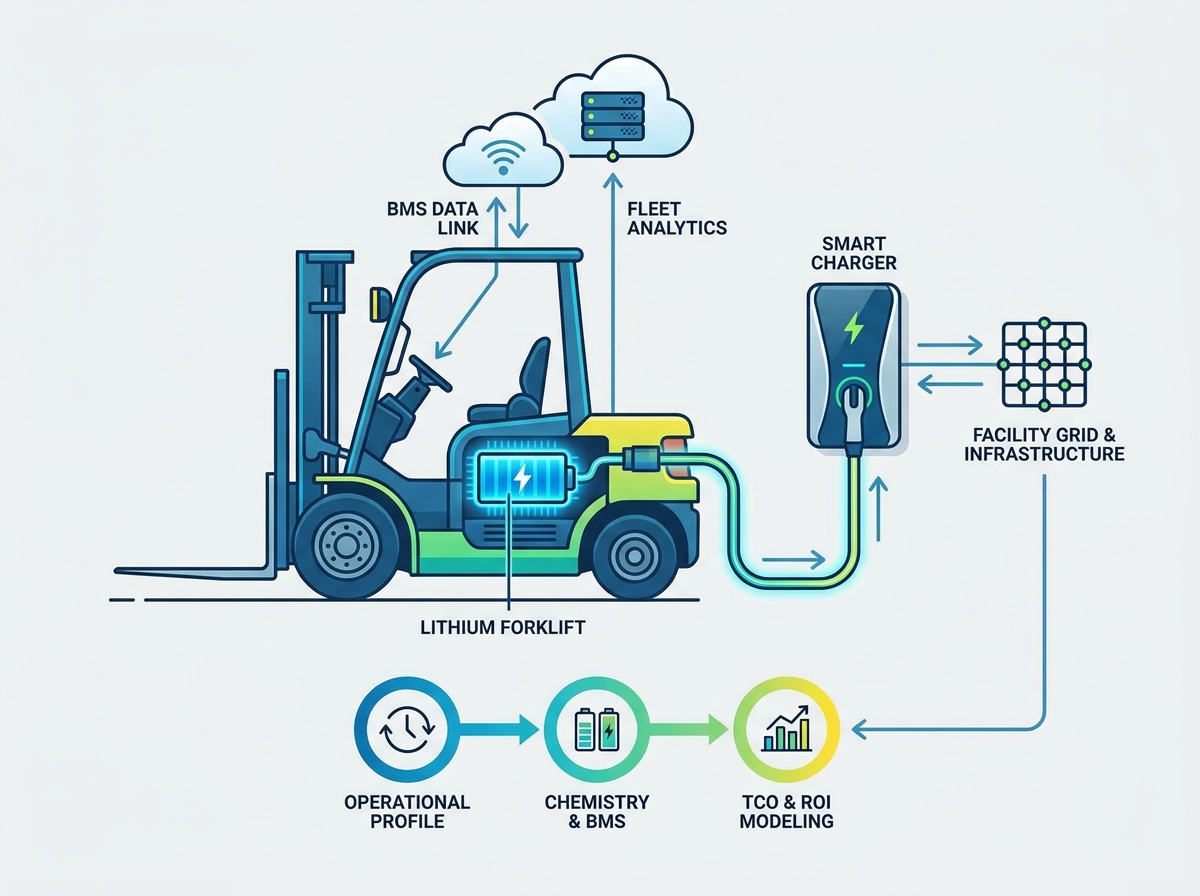
Understanding solution categories is non-negotiable for buyers. The market offers various technologies under the "lithium" umbrella. Differentiating between them protects your operation. You must look past marketing buzzwords. Focus strictly on cellular chemistry and electronic management.
Two primary chemistries dominate the material handling industry. These are Lithium Iron Phosphate (LFP) and Nickel Manganese Cobalt (NMC). LFP stands as the preferred chemistry for industrial applications. It offers superior thermal stability compared to NMC. LFP cells resist dangerous thermal runaway events. They simply do not combust easily under physical puncture. This makes them incredibly safe for chaotic warehouse environments.
LFP also delivers exceptional cycle life. Industrial users typically see over 3,000 charging cycles from LFP packs. NMC packs degrade much faster under heavy industrial use. NMC offers higher energy density, meaning lighter packs. However, extreme lightness is rarely beneficial in forklifts. Remember, forklifts need physical weight for stability. Therefore, LFP remains the undisputed champion for industrial material handling.
The following comparison illustrates key differences between these dominant chemistries:
| Feature Category | Lithium Iron Phosphate (LFP) | Nickel Manganese Cobalt (NMC) |
|---|---|---|
| Thermal Stability | Excellent (Highly resistant to overheating) | Moderate (Requires complex cooling) |
| Cycle Life | 3,000+ cycles | 1,000 - 2,000 cycles |
| Safety Profile | High (Extremely low risk of thermal runaway) | Moderate (Combustible under severe puncture) |
| Material Handling Fit | Ideal (Adds necessary counterbalance weight) | Poor (Often too lightweight for stability) |
The Battery Management System (BMS) acts as the brain of the forklift. Cellular chemistry means nothing without intelligent control. The BMS constantly monitors every single cell inside the casing. It balances voltages during charging and discharging phases. You must verify several critical protections before purchasing.
Check for the following mandatory safety overrides:
You should also demand advanced telematics integration. Modern facilities run on data. A high-quality BMS provides cloud-based dashboards. Fleet managers use these tools to monitor battery health remotely. You can track the State of Charge (SOC) in real-time. You can analyze daily utilization rates across different shifts. This data helps identify inefficient driving habits. It also highlights underutilized equipment in your fleet.
Implementation realities often surprise new buyers. The most common point of failure is facility readiness. You can buy the best truck on the market. However, it will fail if your warehouse cannot support it. You must evaluate your physical infrastructure thoroughly.
High-frequency fast chargers draw significant electrical amperage. A single charger might require a 480V 3-phase connection. Now multiply that by twenty trucks charging simultaneously. This sudden spike strains older facility grids heavily. You must conduct a comprehensive facility power audit before signing any purchase orders. Engage a licensed electrical contractor immediately.
Your contractor should measure peak load capacities. They must evaluate your current transformers and breaker panels. You need to ensure the warehouse grid handles simultaneous opportunity charging. Facility upgrades are sometimes mandatory. Laying new conduit and upgrading transformers takes time. You must factor these timelines into your deployment schedule. Ignoring the power grid leads to tripped breakers and localized blackouts.
Modernizing your fleet unlocks valuable real estate. Traditional systems require massive charging rooms. You need dedicated ventilation systems to extract explosive hydrogen gas. You also need safety infrastructure like emergency eyewash stations. Acid-resistant flooring is another space-consuming necessity.
Switching to modern power systems eliminates these requirements entirely. You can dismantle the old battery room safely. Calculate the total square footage you will reclaim. You can convert this area into revenue-generating storage space. Some facilities use this reclaimed space for staging areas. Others build new quality control stations. This floor space reallocation provides immediate operational value.
You must ensure all hardware meets strict local compliance standards. Never deploy uncertified electrical equipment. Verify that charging hardware carries appropriate safety listings. The battery packs themselves must pass rigorous testing protocols.
Request documentation directly from the manufacturer. Keep these certificates on file for safety inspectors. Compliance protects your workforce from catastrophic electrical failures. It also shields your company from severe regulatory fines.
Evaluating vendor reliability is just as important as evaluating the hardware. How you audit the manufacturer matters immensely. A poor vendor relationship turns a great product into a nightmare. You must establish strict evaluation dimensions.
You must look beyond the flashy headline warranties. A "10-year warranty" sounds impressive on a brochure. However, the fine print often tells a different story. Read the warranty document word by word. Look for hidden throughput clauses. Many vendors limit the total Amp-hours (Ah) the battery can process. Once you hit that Ah limit, the warranty voids immediately, regardless of the years passed.
Check for strict cycle limits. Industrial warranties usually cap at a specific cycle count. Furthermore, watch out for prorated terms. A prorated warranty decreases in value over time. If a failure occurs in year seven, you might only receive a 20% credit toward a replacement. Demand a full-replacement warranty for at least the first five years of operation.
Does the battery communicate seamlessly with the forklift's internal controller? This requires sophisticated CAN bus integration. The Controller Area Network (CAN) acts as the nervous system of the truck. The battery must talk to this network continuously.
Lack of communication leads to severe operational blind spots. Operators will see random dashboard error codes. The battery gauge might display inaccurate readings. In worst-case scenarios, the truck's hydraulic lifting system might fail unexpectedly. Always ask the vendor to prove OEM compatibility. Request a demonstration showing the battery integrating flawlessly with your specific forklift make and model.
You cannot afford extended downtime in a busy warehouse. Assess the vendor's local technician network carefully. A great warranty means nothing if the technician lives four states away. Ask for concrete response times in writing. Your Service Level Agreement (SLA) should guarantee on-site support within 24 hours.
Investigate their spare parts availability. Where do they warehouse their replacement components? If they ship parts from overseas, you might wait weeks for a simple relay switch. Choose vendors who maintain robust domestic parts inventories. Prioritize partners who stock critical BMS components locally.
Buying a Lithium battery forklift truck remains a holistic ecosystem decision. It involves carefully balancing the truck, the advanced battery, the fast charger, and your facility's power grid. You must align your shift intensity with the correct LFP chemistry and charging strategy. You also need to audit your electrical infrastructure rigorously to avoid implementation delays.
We encourage buyers to take a measured approach. Request a thorough site audit first. Consider launching a pilot program with a single unit before rolling out a full-fleet conversion. This pilot allows your operators to test the equipment under real conditions. Offer your engineering team time to evaluate the telematics data. Finally, use localized operational savings calculators to project your long-term efficiency gains accurately.
A: Yes, they can operate outdoors, but you must verify the Ingress Protection (IP) rating. Ensure both the battery pack and the chassis carry a rating of IP65 or higher. This rating guarantees the system remains fully sealed against high-pressure water jets and heavy rainfall during yard operations.
A: It typically takes 1 to 2 hours to reach a full charge. This timeframe depends heavily on the charger's amperage output and the battery's total capacity. This rapid charging profile makes the technology perfectly suited for opportunity charging during brief operator breaks and shift changes.
A: Yes, you absolutely need a specialized charger. Lithium systems require high-frequency chargers designed to communicate directly with the truck's internal BMS via CAN bus. This constant communication safely manages the voltage profile, prevents cellular degradation, and eliminates the risk of overcharging.


