
Views: 0 Author: Site Editor Publish Time: 2026-11-09 Origin: Site


Transitioning your business fleets from internal combustion engines is a major step. It is never just a simple vehicle swap. You must navigate a highly complex procurement ecosystem. Fleet managers face a multi-layered acquisition decision. You must assess the vehicles alongside charging infrastructure and operational software. Switching to electric mobility offers excellent long-term financial returns. It also helps you meet essential environmental benchmarks. However, you need careful upfront planning. You must evaluate grid capacity limits and realistic payload constraints before signing any contracts. This guide covers the critical steps of electric fleet acquisition. You will learn how to align vehicle capabilities with daily duty cycles. We will also explore how to plan depot charging and utilize advanced telematics. By the end, you will have a clear, actionable blueprint. You will be fully prepared to pilot your first commercial electric car successfully.
You must establish a clear financial baseline before purchasing a commercial electric car. The initial purchase price is undeniably higher than traditional vehicles. However, projected operational savings often balance this steep premium over time. Electricity rates are generally lower and much more stable than fossil fuel prices. You will also see drastically reduced preventative maintenance costs. Electric motors have fewer moving parts than combustion engines. They do not require oil changes, spark plugs, or transmission fluid. Furthermore, regenerative braking significantly extends the life of brake pads.
Next, you must strictly factor in infrastructure capital expenditures. You should include the cost of Level 2 or Level 3 fast chargers. Do not ignore the hidden costs of physical installation. Trenching for cables, permitting fees, and utility grid upgrade costs heavily impact your baseline budget. These facility investments are mandatory for long-term fleet viability.
Residual value risks present another major financial variable. Commercial electric depreciation models are still evolving rapidly. Battery life cycles directly influence resale values in the secondary market. A degraded battery severely limits the residual worth of the asset. You should monitor industry auction data closely to model these depreciation risks accurately.
Finally, you must evaluate asset downtime. Charging an electric battery takes substantially longer than refueling a gas tank. You must analyze how these charging intervals impact asset utilization. Quick turnaround times may require strategic scheduling adjustments. Your financial models must account for any potential loss in daily operational hours.
Advertised battery range rarely matches harsh commercial realities. A standard range estimate diminishes quickly under heavy operational demands. Heavy cargo payloads significantly reduce maximum driving distance. Extreme cold or intense summer heat drains battery reserves much faster. Highway speeds and constant HVAC usage also lower overall energy efficiency. You must aggressively account for these real-world variables during procurement.
Start your evaluation by analyzing your daily duty cycles. You should audit your existing telematics data carefully. Look for low-hanging fruit within your current logistics operations. Identify routes featuring predictable and fixed daily mileage. Vehicles returning to a central depot every night are ideal candidates. They offer a controlled environment for reliable overnight charging.
Payload and cargo volume constraints require precise calculation. Electric vehicle battery packs are incredibly heavy. This extra weight directly impacts the Gross Vehicle Weight Rating (GVWR). A higher curb weight means less usable cargo capacity for your deliveries. You must ensure your delivery weight limits align with these physical constraints. Failing to calculate payload drops can render a vehicle useless for heavy freight.
Here is a breakdown of current market availability and vehicle classes:
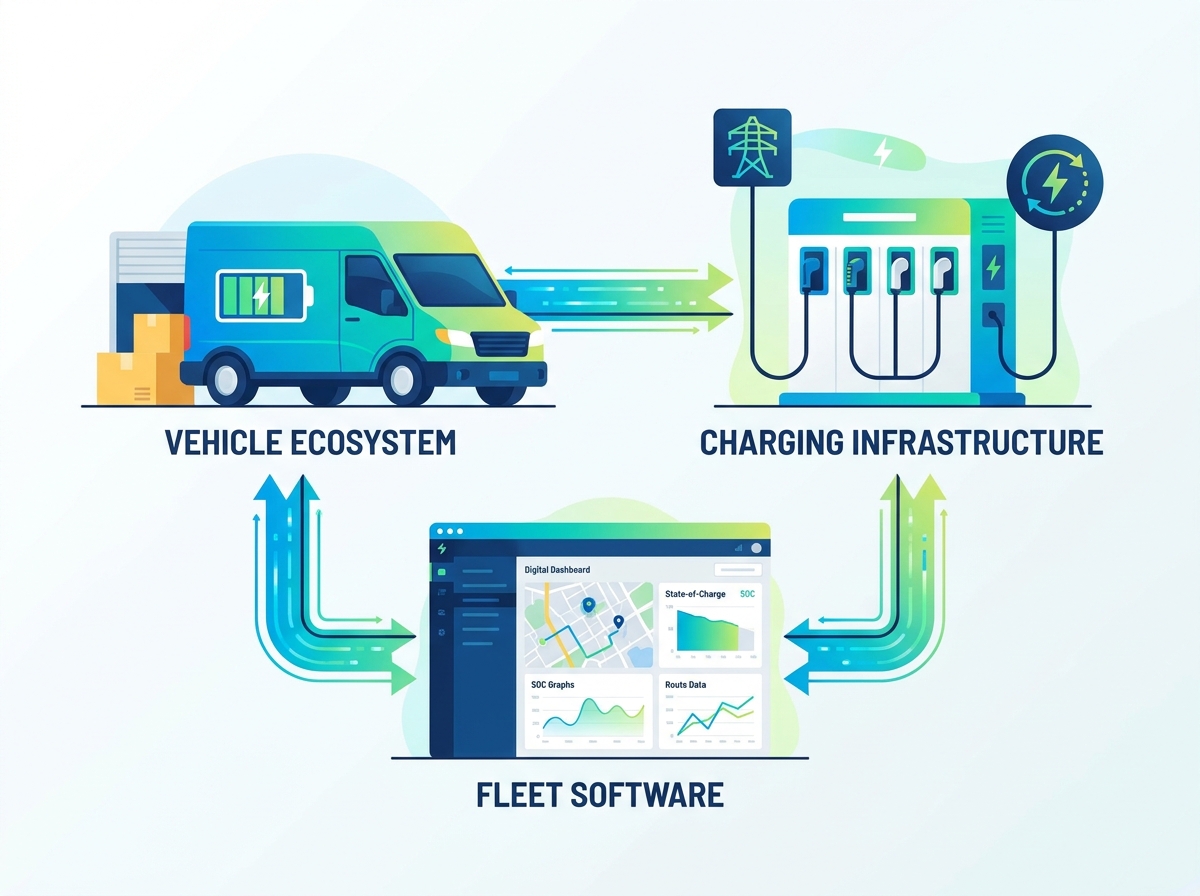
Relying on public charging networks is a high-risk strategy. Commercial fleets simply cannot afford unpredictable wait times at public stations. Broken chargers or occupied stalls cause severe route delays. Driver productivity drops when they waste hours searching for power. You must prioritize behind-the-fence depot charging. This approach guarantees your vehicles are fully ready for their morning shifts.
You must select the right charging hardware for your facility. Level 2 hardware is cost-effective and ideal for overnight charging. It works perfectly when vehicles have dwell times of eight hours or more. Level 3 DC Fast Charging requires high capital investment. However, it is strictly necessary for slip-seat operations running double shifts. You also need it for rapid mid-shift top-ups.
| Charging Level | Relative Cost | Best Use Case | Charging Speed |
|---|---|---|---|
| Level 2 (AC) | Low to Moderate | Overnight depot dwell (8+ hours) | Slow and Steady |
| Level 3 (DCFC) | High | Slip-seat or mid-shift top-up | Fast (under 1 hour) |
Building a strong utility company partnership is critical. Infrastructure implementation timelines often take several months to complete. You must engage local utility providers long before ordering vehicles. They need to assess your site’s current electrical capacity. They will determine if new transformers or grid upgrades are necessary. Skipping this step leads directly to stranded assets and unusable vehicles.
You also need smart charging and load management software. This technology staggers charging times across your fleet overnight. It helps you avoid expensive peak utility demand charges. A smart system automatically pauses charging during high-cost electricity hours. You optimize your daily electricity costs while maintaining full fleet readiness.
Legacy telematics platforms fall entirely short for electric fleets. Traditional GPS tracking simply does not provide enough actionable data. Fleet managers need real-time State of Charge (SOC) visibility. You must know exactly how much battery power remains during an active route. Without accurate SOC data, range anxiety becomes a daily operational hazard.
Intelligent routing software solves many of these modern challenges. Advanced systems route vehicles based on topography and live traffic patterns. Climbing steep hills drains batteries faster than driving on flat highways. The software calculates real-time battery drain based on current cargo weight. If a route requires more energy, the software adapts instantly. It seamlessly incorporates optimal charging waypoints into the driver’s schedule.
Charge Management Software (CMS) is equally vital for daily success. Integrating a CMS with your fleet telematics prevents facility electrical overloads. The software ensures vehicles are adequately charged for specific next-day assignments. It prioritizes charging for vehicles holding early morning dispatches. It automatically slows the charge rate for vehicles leaving later in the day. This intelligent sequencing balances the electrical load perfectly.
Federal and local incentives drastically lower your initial acquisition barriers. You should research current commercial clean vehicle credits thoroughly. Federal grants and state-level rebate programs offset high upfront procurement costs. Many regional governments also subsidize depot charging station installations. You must build a dedicated framework to capture these available funds.
Navigating regulatory pressures is becoming a daily reality. Zero-emission vehicle (ZEV) mandates are expanding across major global cities. Urban centers are creating strict low-emission zones prohibiting older diesel trucks. Adopting electric fleets early hedges against future compliance penalties. Proactive adoption turns regulatory compliance into a distinct competitive business advantage.
Electric vehicles also streamline Corporate Sustainability (ESG) reporting. Electric fleet adoption provides verifiable Scope 1 carbon reduction data. You can present this transparent data to demanding corporate stakeholders. Green supply chains are now a strict requirement for many lucrative contracts. Proving your fleet operates emission-free helps you win new B2B business.
We highly recommend you start small and scale gradually. Deploy a micro-pilot program consisting of one to five vehicles. Assign them to your most predictable and shortest urban routes. This isolated deployment allows you to validate your assumptions safely. You can measure real-world battery performance before committing to a massive rollout.
Driver training and employee buy-in dictate your pilot's ultimate success. Driving an electric vehicle feels remarkably different than a combustion truck. Regenerative braking systems require dedicated practice to master efficiently. Drivers need proper retraining to achieve maximum range and operational safety. Engaged drivers actively help you extract the most value from the technology.
Establish strict vendor evaluation criteria before signing binding contracts. You must ask OEMs and commercial dealers the hard questions. Clarify battery warranty specifics and capacity degradation guarantees. Demand priority service agreements to minimize potential maintenance downtime. Verify the immediate availability of replacement parts in your specific region.
Your next steps should be clear and decisive. Consult with an infrastructure specialist to evaluate your depot's electrical panels. Book a fleet software demo to understand modern telematics integration. You can also download dedicated calculators to forecast your operational savings accurately. By taking these actions, you set a solid foundational strategy.
Acquiring an electric fleet requires a highly strategic decision-making framework. You must align new vehicle capabilities with realistic daily duty cycles. Securing your charging infrastructure early is completely non-negotiable for success. Utilizing EV-specific software guarantees your daily logistics operations run smoothly and efficiently.
Successful commercial adoption is always driven by hard operational data. Guesswork leads directly to stranded assets and blown procurement budgets. You must audit your current routes and collaborate deeply with utility providers. Careful preparation ensures you deploy reliable assets that improve your bottom line.
Take the next logical step in your fleet procurement journey today. Reach out to a certified fleet electrification consultant to outline your transition. Begin assessing your depot's electrical capacity immediately. Preparing your infrastructure now will effectively future-proof your delivery business for decades.
A: Commercial EV batteries generally offer excellent longevity. Most manufacturers provide warranties spanning eight years or 100,000 miles. Battery degradation happens slowly over time, usually losing 1-2% capacity annually. You can expect a battery to remain highly functional for roughly a decade before requiring replacement.
A: Freezing temperatures significantly impact battery chemistry and efficiency. You should expect a realistic range drop between 20% and 40% in extreme cold. Heating the cabin draws massive power from the battery. Modern vehicles mitigate this using advanced thermal management systems and efficient heat pumps.
A: Your current commercial policy can cover electric vehicles, but adjustments are necessary. Insurance premiums often run higher for electric fleets. This increase stems from higher vehicle replacement costs and expensive battery packs. You may also need specialized repair networks equipped to handle high-voltage electrical systems safely.
A: Grid outages pose a serious risk to fleet readiness. You must establish decentralized charging contingency plans. Many fleets install diesel backup generators to maintain limited charging capabilities. Advanced depots utilize microgrids integrating solar panels and stationary battery storage to ensure uninterrupted operations.


