
Views: 0 Author: Site Editor Publish Time: 2026-08-09 Origin: Site


Material handling is undergoing a massive shift across global supply chains. Upgrading your warehouse fleet is no longer just a basic equipment purchase. Instead, buying an Intelligent forklift truck represents a major software and operational infrastructure investment. We must strip away the confusing marketing jargon first. An intelligent machine relies on advanced integrated technologies rather than just mechanical power. These capabilities include real-time telematics, autonomous navigation (AGV) systems, predictive maintenance sensors, and direct WMS integration. This guide will help operations managers and procurement teams navigate this complex landscape. You will learn how to properly evaluate essential features for your facility. We will help you calculate accurate pricing structures. Finally, you will discover how to avoid common implementation traps that delay operational returns.
Start by understanding distinct autonomy levels in modern equipment. Operator-assist telematics simply guide human drivers using digital displays. Semi-autonomous models handle basic travel between aisles. However, they still require human intervention for complex pallet picks. Fully autonomous systems operate entirely independently.
Next, evaluate navigation systems carefully. Simultaneous Localization and Mapping (SLAM) builds digital facility maps dynamically. SLAM offers great flexibility if your warehouse layout changes frequently. Vision-based navigation relies on cameras recognizing physical infrastructure. Vision systems struggle in poor lighting. Yet, they excel in highly structured, static aisles. You must choose based on your specific operational layout.
Safety directly impacts your bottom line. An Intelligent forklift truck uses advanced environmental sensors. LiDAR scanners map surroundings in real time. 3D cameras detect low-hanging obstacles like rack overhangs. Dynamic speed reduction automatically slows the truck near pedestrian zones. These features drastically reduce inventory damage. They also lower workplace liability risks. A common mistake is purchasing cheap, single-tier sensors. Always prioritize multi-tier sensor redundancy for maximum safety.
Downtime destroys profitability quickly. Predictive maintenance solves this chronic problem. Intelligent systems monitor battery State of Health (SOH) continuously. They track charge cycles and temperature fluctuations. They also feature impact detection systems. If a collision occurs, the system logs the data immediately. Automated maintenance alerts notify technicians before a mechanical part fails. This prevents catastrophic equipment downtime during peak shifts. Fleet telematics transform reactive repairs into proactive scheduling.
Hardware holds no value without intelligent software. Seamless API handshakes are absolutely mandatory. Your new fleet must communicate directly with existing ERP platforms. It must integrate with your Warehouse Management System perfectly. If integration fails, data silos form immediately. A reliable fleet management system orchestrates daily task assignment. It tracks inventory movement in real time.
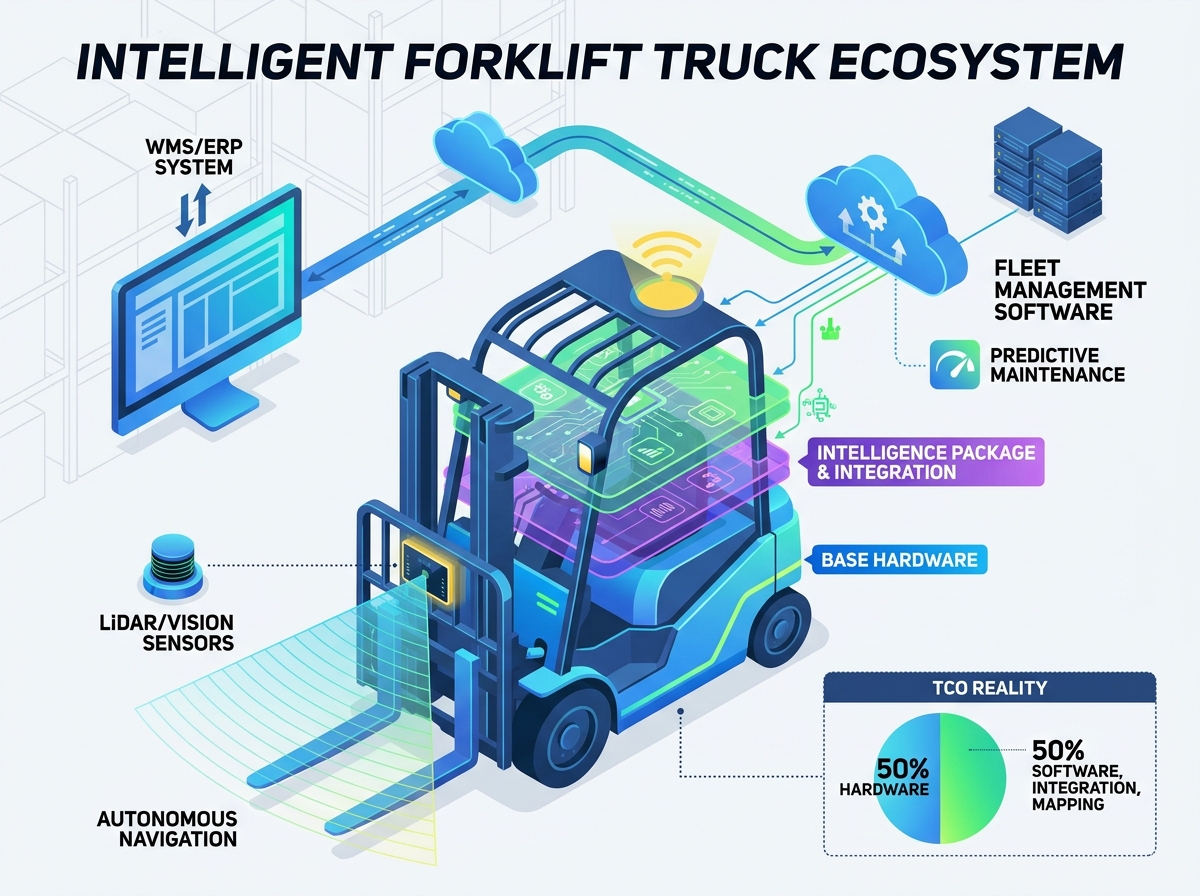
Let us examine the base hardware costs first. A standard electric truck serves as the structural foundation. However, the intelligence package adds significant expense. This package includes LiDAR sensors, onboard computers, and advanced motor controllers. The base electric truck might seem affordable initially. Yet, adding automation hardware often doubles the upfront price tag.
Do not overlook ongoing software expenses. Intelligent fleets rely heavily on subscription models. You will pay SaaS fees for fleet management dashboards. Cloud storage for operational analytics costs extra every month. Over-the-Air (OTA) update packages require yearly renewals. OTA updates keep your equipment secure from cyber threats. They also optimize travel routing algorithms. Factor these recurring costs into your budget early.
Hidden fees often surprise procurement teams. Facility mapping requires specialized engineers on-site. IT network upgrades are frequently necessary for seamless operations. An Intelligent forklift truck demands robust wireless connectivity. You might need dedicated 5G networks. Upgrading enterprise Wi-Fi routers is another common requirement. System integration consulting adds thousands to the final bill.
Traditional mechanical maintenance focuses on grease, hydraulics, and gears. Intelligent system maintenance is entirely different. You must purchase Service Level Agreements (SLAs) for software support. Sensors require regular recalibration by certified technicians. Remote IT support handles sudden software glitches. Mechanical parts wear out slower due to optimized driving. However, electronic support costs rise significantly over time.
| Cost Category | Traditional Forklift | Intelligent Forklift Truck |
|---|---|---|
| Base Hardware | Standard industrial pricing | Premium pricing (Sensors + Computers) |
| Software Licensing | None | Monthly SaaS & OTA update fees |
| Maintenance Type | Mechanical repairs & parts | Sensor recalibration & IT SLAs |
| Infrastructure Needs | Standard charging stations | Facility mapping & 5G/Wi-Fi upgrades |
Physical warehouse conditions dictate project success. You must outline strict physical requirements before buying. Floor gradient tolerances are incredibly tight for automated machinery. Too much slope disrupts autonomous navigation systems. Potholes or severe cracks trigger emergency stops.
Aisle width minimums are non-negotiable. The equipment needs clearance to turn and lift safely. Optical sensors require adequate, consistent lighting conditions. Shadows or harsh glare confuse vision-based navigation. A rigorous site survey reveals these limitations early. Never skip the initial facility audit.
Network stability is vital for safe operations. Let us discuss the dangers of network latency. Dead zones in warehouse connectivity cause sudden equipment stops. An Intelligent forklift truck needs uninterrupted data flow. Without it, the machine cannot function safely. Invest in a thorough IT network assessment immediately. Ensure seamless data handoffs between Wi-Fi access points.
Here are critical steps for evaluating network readiness:
Change management remains a tough hurdle. Floor staff often fear automated equipment initially. You must train human workers properly. Teach them how to interact safely with semi-autonomous units. Establish clear right-of-way rules in mixed aisles. Human-machine collaboration boosts overall efficiency when managed correctly. Transparent communication builds trust across your workforce.
Establish hard metrics before calling any vendors. What defines success for your operation? Target a specific percentage reduction in pallet movement time. Aim for a measurable decrease in impact incidents. Clear criteria prevent project scope creep. They hold vendors accountable for promised performance.
Not all hardware vendors are equal. Assess their software maturity deeply. Check local technician availability in your specific region. Verify their spare parts lead times. Avoid flashy startups possessing great software but terrible hardware supply chains. Hardware reliability matters just as much as brilliant code. You need a partner capable of rapid physical repairs.
Never rush a massive fleet-wide rollout. Demand a strict 30-to-90-day pilot program first. Run this pilot on your most standard, repetitive route. This controlled environment exposes hidden software bugs. It highlights network dead zones safely. A successful pilot builds a strong business case for expansion. If a vendor refuses a pilot, walk away immediately.
Evaluate your purchasing models carefully. Traditional capital expenditure (CapEx) requires huge upfront cash. Operating expenditure (OpEx) offers greater flexibility. Consider Leasing or Robotics-as-a-Service (RaaS) models. RaaS shifts maintenance risks back to the vendor. You only pay for successful operational hours. This model guarantees the vendor remains invested in your uptime.
Purchasing an Intelligent forklift truck fundamentally changes your warehouse. It represents a strategic IT and operations alignment. It is never just a simple machinery replacement. Successful deployments require meticulous planning, robust wireless networks, and clear success metrics. Your next action is clear. Conduct a comprehensive internal site readiness audit today. Then, request a detailed lifecycle pricing projection from a shortlisted integrator. Start small with a controlled pilot. Validate the technology thoroughly, and scale your operations confidently.
A: The financial return typically takes 18 to 36 months. You must balance upfront integration time against long-term labor savings. While initial setup is costly, reduced inventory damage and continuous 24/7 operational capabilities accelerate your financial returns significantly.
A: Current technological limitations make outdoor operations difficult. Heavy rain, snow, and bright sunlight interfere with LiDAR and vision sensors. Loading docks also present challenges due to steep dock plate transitions. Most intelligent units perform best in controlled, indoor environments.
A: Buying used automation technology carries high risks. You often encounter outdated sensors and unsupported legacy software. Degraded battery life is another major concern. Always verify that the original manufacturer still provides OTA updates and spare parts before buying used.
A: No, full automation is not required. Many facilities successfully run hybrid environments. You can mix human-driven equipment with intelligent units. Gradual automation scaling allows you to automate simple, repetitive routes first while humans handle complex, variable picking tasks.


