
Views: 0 Author: Site Editor Publish Time: 2026-08-06 Origin: Site


Transitioning from manual material handling to automated workflows demands careful operational planning. You cannot simply buy new hardware and expect an immediate productivity boost. You must integrate a complex robotic system into your existing operational ecosystem. The market for automated guided vehicles and autonomous mobile robots is heavily saturated. Vendors frequently flood the industry with promises of instant returns and zero friction. However, real-world success depends entirely on stringent technical alignment and detailed preparation.
We built this comprehensive guide to help you navigate these complex choices confidently. It provides a vendor-neutral, evidence-based framework for evaluating and shortlisting the right equipment. You will learn how to properly evaluate an Intelligent forklift truck to match your specific physical constraints, software infrastructure, and financial targets.
Before reviewing vendor brochures, you must look closely at your own facility. Your physical warehouse space dictates which equipment will actually function properly. Ignoring baseline audits leads to immediate deployment failures.
Document your maximum load weights meticulously. You must record exact pallet dimensions and identify the specific center of gravity for your inventory. Consider capacity derating carefully during this phase. When an Intelligent forklift truck raises a heavy load to a high rack, the physics change dramatically. Its safe carrying capacity drops to maintain stability. Map these operational limits against your heaviest items to prevent dangerous tipping hazards.
Measure your minimum aisle widths physically instead of relying on outdated facility blueprints. Distinguish clearly between very narrow aisles (VNA) and standard storage aisles. Document your turning radii and measure transfer aisle dimensions accurately. Automated vehicles follow strict geometric paths programmed into their software. They cannot intuitively squeeze past temporary pallet obstructions like a human operator might.
Assess your concrete floor conditions with absolute scrutiny. Incline gradients severely affect braking distances. Uneven surfaces cause mast sway at high lift heights. Deep expansion joints can damage specialized robotic wheels over time. Environmental limits also play a massive role in hardware selection. Temperature extremes degrade battery life rapidly. Airborne dust coats optical sensors and causes navigation faults. Indoor-to-outdoor transitions require specialized weather-rated components and highly durable tire selection.
Define your required operational cycles per hour precisely. Automated machinery typically operates at slower, highly regulated speeds. Manufacturers limit these speeds heavily to ensure strict safety compliance. Your fleet sizing strategy must account for this safety-speed trade-off. You might require multiple automated units to match the raw movement speed of a single experienced human driver.
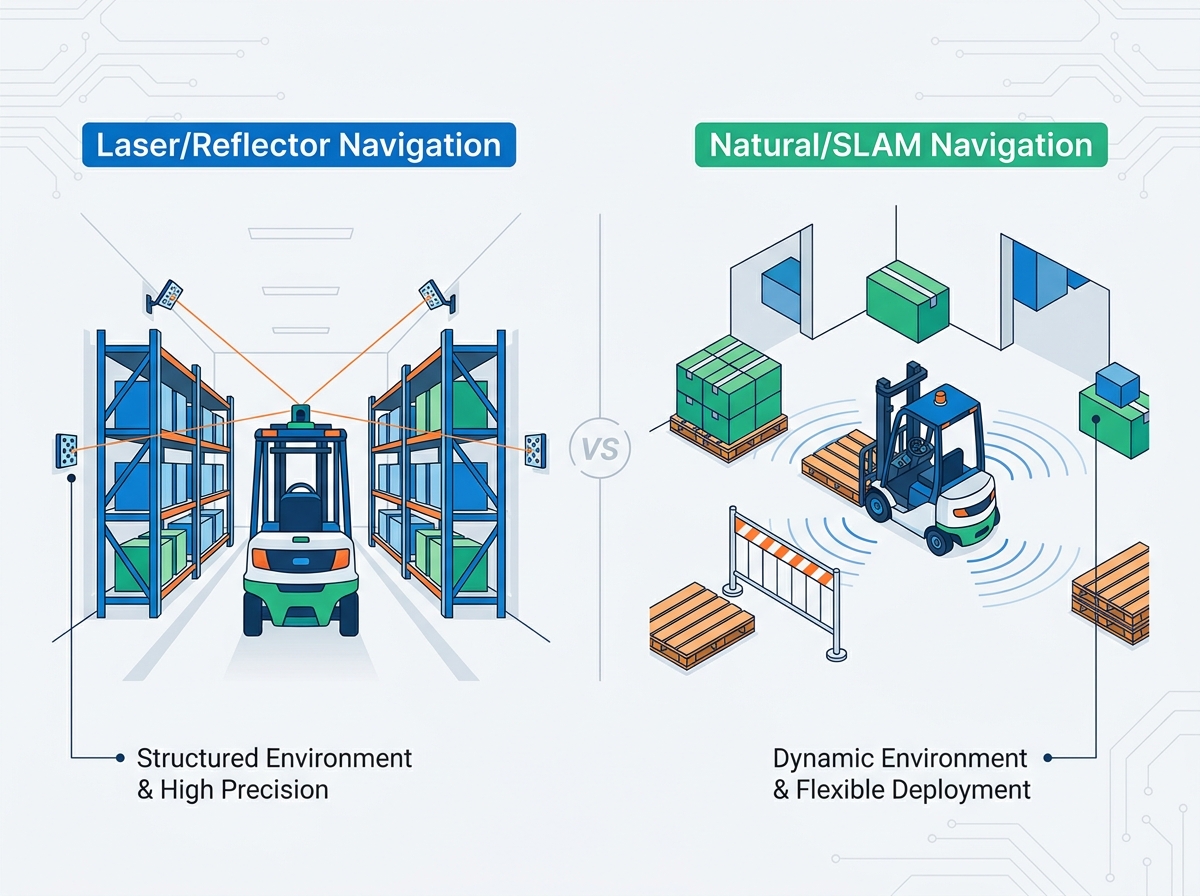
Choosing the correct navigation technology dictates your project's overall success. You must match the underlying technology to your facility's layout permanence and environmental volatility.
This traditional method relies on physical reflective targets placed high on facility walls and racking.
Simultaneous Localization and Mapping (SLAM) uses onboard laser scanners to read natural facility features.
Modern systems use advanced semantic cameras to map spaces intelligently. You must scrutinize vendor claims regarding obstacle avoidance closely. Distinguish between basic and advanced robotic behaviors. Basic machines simply trigger an emergency stop when a path is blocked. True autonomous mobile robots dynamically recalculate new routes around unexpected obstacles. They use AI to recognize objects contextually, distinguishing between a dropped cardboard box and a human worker.
| Navigation Technology | Ideal Environment | Infrastructure Needs | Flexibility Level |
|---|---|---|---|
| Laser/Reflector | Static, fixed racking | High (Target installation) | Low |
| Natural / SLAM | Dynamic, cross-docking | Zero to Minimal | High |
| Vision-Based AI | Highly volatile, mixed traffic | Zero | Maximum |
Hardware represents merely a physical execution tool. Software integration dictates your true operational efficiency. Failing to map your digital infrastructure leads to isolated, inefficient machines.
The equipment relies entirely on the data feeding it from your central servers. You must evaluate the vendor’s API documentation thoroughly. Look for native integration capabilities. Connecting an Intelligent forklift truck directly to platforms like SAP, Manhattan, or Blue Yonder is ideal. Seamless interoperability prevents dropped orders and ensures real-time inventory tracking without expensive middleware solutions.
Look for decentralized traffic control capabilities within the Fleet Management System (FMS). A robust FMS prevents crippling facility gridlock. When multiple vehicles operate in confined narrow aisles, they need intelligent right-of-way logic. Decentralized systems allow robots to negotiate passing rules dynamically, rather than waiting for a central server to resolve traffic jams.
Enterprise scalability demands absolute flexibility. Verify if the equipment natively supports the VDA 5050 standard. This standardized communication interface is critical for long-term growth. It prevents expensive vendor lock-in. VDA 5050 allows you to manage a mixed fleet easily. You can run automated vehicles from different manufacturer brands under one master control system without compatibility clashes.
Review all underlying communication protocols carefully. Determine if the system uses local edge servers or cloud-based processing. Cloud processing introduces potential latency during peak network hours. Edge servers keep machine responses instant and localized. Ensure your Wi-Fi network security aligns perfectly with internal IT compliance requirements, particularly regarding encryption and access control.
Evaluating financial impact requires looking far beyond the initial hardware sticker price. You must analyze the complete financial lifecycle of the deployment to understand the true return on your investment.
Compare outright hardware purchases against flexible leasing frameworks. Robotics-as-a-Service (RaaS) offers a highly compelling alternative for modern facilities. Leasing models bundle routine maintenance and essential software updates together. They transform massive capital expenditure into predictable monthly operational costs. This approach also shifts the technology obsolescence risk back to the vendor.
Always budget heavily for hidden facility integration costs. Warehouses rarely sit "robot-ready" on day one. You may need expensive floor grinding to meet strict Fmin flatness ratings. Super flat floors are mandatory for high-reach applications to prevent mast sway. Upgrading your Wi-Fi density is almost always required to eliminate dead zones. You might also need to paint standardized floor markings to assist optical sensors.
Factor your battery technology choices into the budget immediately. Lithium-ion batteries support rapid opportunity charging during shift breaks. Traditional lead-acid batteries require dedicated, ventilated swapping rooms. Evaluate the capital cost of implementing automated charging stations. Some advanced fleets utilize automated battery swapping infrastructure to maintain continuous 24/7 operations.
Calculate your return on investment timeline comprehensively. Compare your operational expenses against measurable daily efficiency gains. Look closely at reductions in product damage. Factor in lower facility wear-and-tear costs. Finally, account for reallocating human labor to higher-value operational tasks rather than simple horizontal transport. A successfully deployed system typically yields a 12 to 24-month payback period.
Safety stands as the absolute highest priority when deploying automated heavy machinery. You must eliminate risks through rigorous planning before any hardware arrives at your loading dock.
Demand formal documentation proving regulatory adherence. Vendors must prove compliance with rigorous global safety standards. ISO 3691-4 governs the safety of driverless industrial trucks globally, dictating strict Performance Levels for safety functions. ANSI/ITSDF B56.5 provides the standard for North American deployments. Never procure uncertified equipment for an industrial setting.
Verify the presence of redundant safety sensors immediately. A single point of failure is unacceptable in automated environments. Demand 360-degree LiDAR safety scanners. These create invisible, dynamically scaling protection bubbles around the moving vehicle. Verify the inclusion of 3D camera blind-spot detection systems. Ensure physical emergency bumpers exist to physically cut drive power upon any contact.
Plan extensive human-machine collaboration training. Organizational change management determines user acceptance. Evaluate how predictable the machine movements are to your human workers. Directional projection lights show exactly where the vehicle intends to turn. Distinct audible signals help workers anticipate movement in noisy environments long before a vehicle rounds a blind corner.
Shortlist vendors based on rigid Service Level Agreements (SLA). Look for a strictly guaranteed Mean Time to Repair (MTTR). Confirm they hold local spare parts inventory to prevent prolonged downtime. Remote diagnostic capabilities are incredibly valuable. They allow remote engineers to resolve software glitches immediately without deploying physical personnel to your site.
***
Selecting an automated handling solution requires moving far past glossy brochure specifications. You must rigorously audit how the machine's software, navigation protocols, and physical footprint map directly to your specific warehouse realities. Every facility presents unique geometric and environmental challenges that off-the-shelf solutions rarely solve perfectly.
Before issuing any Request for Proposal, compile a highly comprehensive dataset. Detail your current load profiles, precise throughput requirements, and IT infrastructure capabilities. Having this data ready forces vendors to provide accurate, customized proposals.
Finally, engage directly with vendors to run a site simulation. Request a limited Proof of Concept (PoC) in a single aisle or a controlled workflow loop. Validating actual performance claims in your own facility is the only proven way to ensure operational success before scaling fleet-wide.
***
A: Implementation ranges from 4 to 12 weeks. This timeline depends heavily on your chosen navigation technology. SLAM software deploys much faster than physical reflector-based systems. The complexity of your warehouse management system integration also significantly impacts the overall rollout schedule.
A: Most models are designed strictly for controlled indoor environments. Outdoor or transition-zone applications require highly specialized equipment. These units need weather-rated sensors, specific durable tire compounds, and advanced localized navigation to handle variable lighting, rain, and uneven outdoor terrain.
A: High-quality models retain localized mapping and basic safety protocols onboard. They will complete their immediate physical task or safely pause operations. However, continuous fleet coordination and new task assignments require stable network connectivity. Always ensure your vendor specifies clear fail-safe behaviors.


