
Views: 0 Author: Site Editor Publish Time: 2026-08-07 Origin: Site


Warehouses face unprecedented demand for rapid order fulfillment today. Procurement teams often confuse "automation" and "intelligence" in material handling today. They use these terms interchangeably, leading to misaligned equipment investments. Purchasing a standard automated system for a highly dynamic warehouse causes major bottlenecks. Conversely, over-investing in AI-driven intelligence for simple, repetitive routes delays your expected returns. You introduce unnecessary operational friction. Warehouse managers face immense pressure to modernize logistics correctly. We must clearly separate rigid automation from adaptive intelligence. This guide provides a transparent, technical breakdown of an Intelligent forklift truck versus a traditional automated forklift. You will learn the core architectural differences, deployment realities, and performance metrics. Operations directors can then use this evidence-based framework to make the right selection for their specific facility. Facilities that choose poorly face massive integration headaches and frustrated floor teams. Understanding these categories is the ultimate prerequisite for supply chain modernization.
Many warehouse operators believe any driverless vehicle acts intelligently. This assumption causes costly deployment errors. We must establish a clear baseline between standard execution engines and adaptive systems. You need accurate terminology to evaluate vendor proposals effectively.
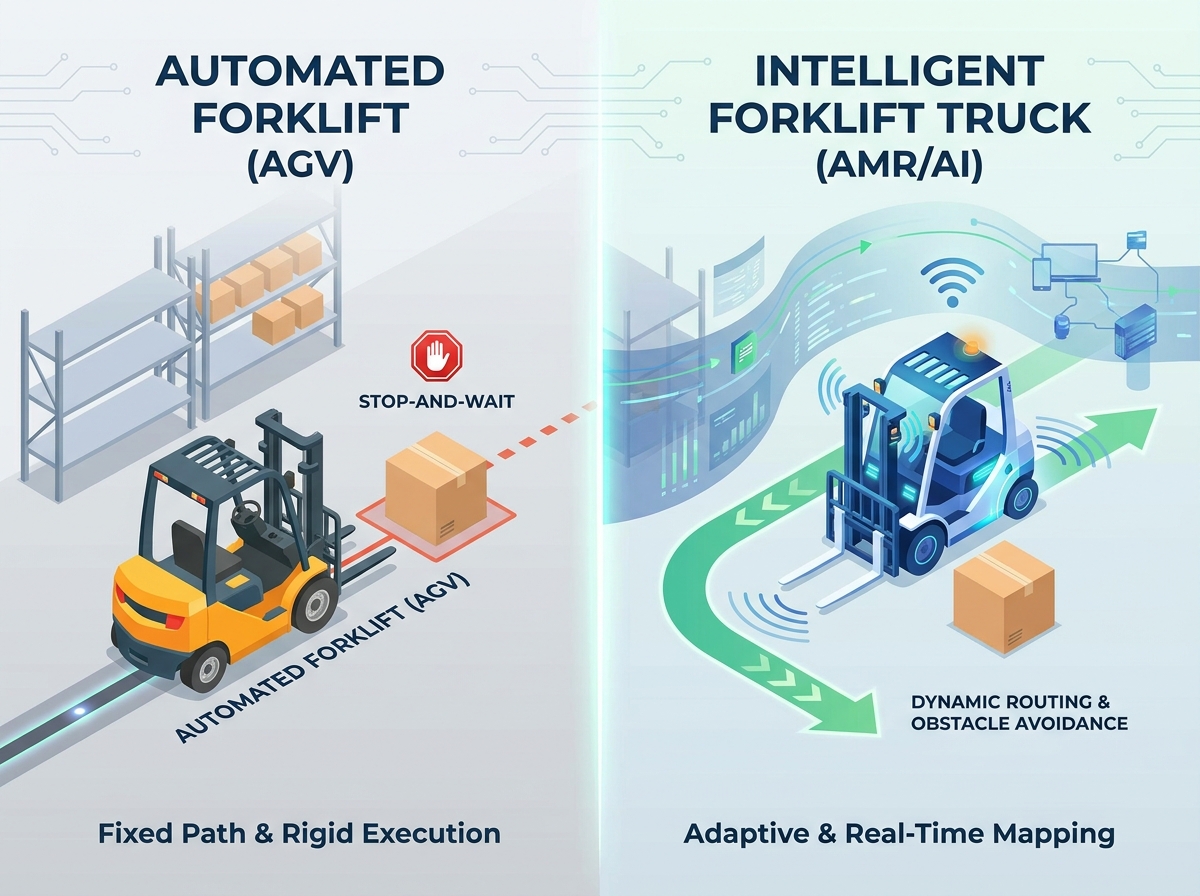
These units replace manual driving for highly repetitive, fixed-route tasks. They rely heavily on traditional Automated Guided Vehicle (AGV) architecture. We see them excel at moving pallets from point A to point B across long, undisturbed corridors. However, their operational reality is extremely rigid. When basic safety sensors detect a sudden obstacle, the machine simply stops in its tracks. It waits indefinitely for manual clearance. They cannot think around the problem or find an alternate route. Their primary goal is strict compliance to a predefined path.
These advanced vehicles utilize edge computing, machine vision, and AI-driven dynamic routing. They often incorporate Autonomous Mobile Robot (AMR) capabilities. Some units offer hybrid modes. These blend manual control options and advanced driver-assist systems (ADAS) smoothly. Their operational reality differs drastically from basic automated models. They execute obstacle circumvention autonomously without human intervention. They perform real-time load identification on the fly using advanced neural networks. They recognize mismatched pallets or poorly stacked goods before lifting them. Furthermore, they integrate actively into your WES or WMS. This allows them to reprioritize tasks dynamically as floor conditions change throughout the shift.
Beneath the physical chassis, these two technologies rely on entirely different operational paradigms. You must understand their underlying architecture to predict their floor performance accurately. The sensors they use dictate how freely they can move.
Automated machinery depends heavily on physical infrastructure modifications. Vehicles navigate via laser triangulation bouncing off wall reflectors. Many use magnetic tape or wire-guided systems buried in the concrete floor. This provides high reliability in strict, unchanging environments. However, it offers terrible adaptability. Moving a rack requires pulling up floor tape.
Conversely, an Intelligent forklift truck uses natural feature navigation natively. It employs 2D/3D LiDAR, optical cameras, and AI SLAM (Simultaneous Localization and Mapping). The system maps your facility digitally, creating a dynamic grid. It updates environmental changes in real-time, requiring zero physical floor guides. If someone drops a box in an aisle, the machine simply recalibrates its path around it instantly.
Standard automated vehicles usually employ basic middleware architectures. They receive simple, one-way dispatch commands from a central server. They do not analyze broader facility workflows or share localized insights. They just execute orders blindly.
Intelligent platforms feature deep, API-driven integration into your overarching WMS or ERP. They process vast amounts of data right at the edge. These systems optimize fleet routing autonomously by analyzing real-time floor congestion. They manage battery charging cycles efficiently, ensuring vehicles only charge during natural operational lulls. They even flag predictive maintenance needs automatically. They act as active, analytical nodes within your broader supply chain network.
Automated forklifts rely on programmable logic controllers (PLCs). They use basic safety lasers meeting PLd/Cat 3 compliance standards. They enforce strict boundary breaches blindly. If an object breaks the laser plane, the machine halts violently to prevent impact. This guarantees safety but ruins efficiency.
Intelligent units possess semantic understanding of their immediate environment. They actually differentiate between a human worker, a dropped pallet, or a structural column. They understand a human might move unpredictably. They adjust their speed and trajectory smoothly based on the specific object category. They maintain strict OSHA and ANSI compliance while keeping goods moving seamlessly around active personnel.
You need more than technical specs to justify a major capital expenditure. We must evaluate how these systems impact daily operational metrics and long-term business returns. Deploying the wrong system cripples facility throughput immediately.
Automated vehicles require a longer physical installation phase. You must shut down aisles to install reflectors on racks. You might need to grind floor tracks into the concrete. This causes severe operational disruption during the setup phase. However, they carry much lower software integration demands overall.
Intelligent models promise much faster physical deployment. Mapping an entire facility takes days, not weeks. Yet, they introduce hidden digital complexities. You must perform rigorous IT security vetting. You need extensive network stress-testing before launch. Complex software integration into your legacy WMS takes careful planning and mapping of API endpoints.
Assess the friction involved when adding new routes. An Intelligent forklift truck scales seamlessly via simple software updates. You draw a new line on a digital map within the central software hub. The entire fleet adapts instantly. You can add fifty new pickup locations in under an hour. Automated models require physical path extensions. You must physically tape or wire the new route before any vehicle can use it.
Evaluate throughput capabilities in highly dynamic environments carefully. Automated systems suffer terribly in mixed-traffic zones. Frequent interactions between humans and machines cause constant "stop-and-wait" delays. Throughput drops dramatically when machines constantly yield to human operators without finding alternative paths. Intelligent systems maintain significantly higher throughput. They use active rerouting to bypass localized congestion entirely. They take an adjacent aisle to reach the same destination without dropping their operational speed.
| Operational Metric | Standard Automated Forklift | Adaptive Intelligent Forklift |
|---|---|---|
| Facility Modifications | Extensive (Reflectors, Magnetic Tape) | None (Digital SLAM Mapping) |
| Route Scaling Speed | Slow (Requires Physical Changes) | Rapid (Instant Software Updates) |
| Obstacle Handling | Halt and Wait for Clearance | Dynamic Route Circumvention |
| Throughput in Mixed Zones | Low (High Stoppage Rates) | High (Fluid Rerouting) |
Buying the most advanced equipment guarantees nothing if your facility cannot support it. You must audit your internal readiness across several distinct categories. High-tech equipment fails quickly inside low-tech environments.
Advanced autonomous vehicles consume massive amounts of data constantly. An intelligent system requires a robust, zero-latency wireless network. You typically need Wi-Fi 6 or a private 5G setup. They process real-time AI computer vision and complex fleet data continuously. A dropped Wi-Fi signal can cause an intelligent machine to pause its AI processing. This creates temporary dead zones on your floor. Standard automated systems remain much less demanding. They often function perfectly fine on legacy or localized RF networks. They execute their simple point-to-point commands without constant cloud connectivity.
Physical environments dictate equipment viability quickly. Standard automated forklifts often require wider turning radii. They demand strict floor leveling to prevent critical navigation errors. You must patch cracks and ensure perfect flatness. You must evaluate how intelligent systems behave differently here. Their advanced suspension and LiDAR stability allow them to handle varying rack heights seamlessly. They navigate tighter, unstructured spaces with greater agility due to precise spatial mapping and smart turning radii.
Change management remains a massive implementation hurdle. You must address how floor staff interacts with these modern machines. Intelligent systems require training staff to work directly alongside adaptive robots. Workers must trust the machine's dynamic avoidance capabilities rather than fearing sudden stops. You must conduct extensive change management workshops. Conversely, automated systems usually mandate strict physical segregation. You build dedicated human zones and separate machine zones to ensure safety. This separation consumes valuable floor space.
Selecting the correct material handling vehicle requires matching technology to your specific operational profile. Equipment capabilities alone should never dictate your final choice. You must look inward at your facility's unique rhythm.
Some operations do not require advanced AI to achieve peak efficiency. Consider this route if:
Dynamic environments punish rigid automation. Consider the adaptive route if:
You can use these findings to build a bulletproof business case. Share this data directly with your procurement team.
The choice between these two distinct technologies rarely comes down to which one is objectively better. Instead, it relies heavily on how well the technology aligns with your specific operational variability. You must match the equipment to your internal IT maturity. Automated systems dominate static, highly predictable environments perfectly. Conversely, an Intelligent forklift truck thrives inside chaotic, high-mix facilities demanding constant adaptability.
We highly recommend conducting a rigorous site audit before making any purchases. Focus intensely on your network infrastructure capabilities. Document your workflow variability thoroughly across multiple shifts. Confirm your WMS compatibility firsthand. Only after gathering this crucial data should you request Proof of Concepts (PoCs) from leading vendors. This proactive approach prevents costly integration delays down the road.
A: While many models operate completely autonomously, several intelligent systems feature a hybrid design. They allow manual operation when needed but retain their AI safety overrides. This ensures maximum flexibility for complex, non-standard tasks while maintaining strict warehouse safety protocols during manual override.
A: Generally, no. Retrofitting traditional AGVs with advanced AMR technology proves highly inefficient. They lack the necessary native edge-computing hardware and deep sensor integration. Buying a purpose-built intelligent system ensures proper hardware-software synergy. It provides much better long-term reliability than a fragmented retrofit.
A: Intelligent models typically achieve positive returns within 18–24 months due to rapid software-based deployment and higher dynamic throughput. Standard automation often requires 24–36 months to break even. Physical setup costs, facility modifications, and rigid routing limitations extend their operational payback period significantly.
A: They do not require one specific brand. However, they rely heavily on modern APIs and robust middleware. They remain largely vendor-agnostic but demand a modern, integrable WMS architecture. Legacy, siloed systems will throttle the advanced fleet routing and data optimization capabilities of these sophisticated vehicles.


