
Views: 0 Author: Site Editor Publish Time: 2026-08-08 Origin: Site


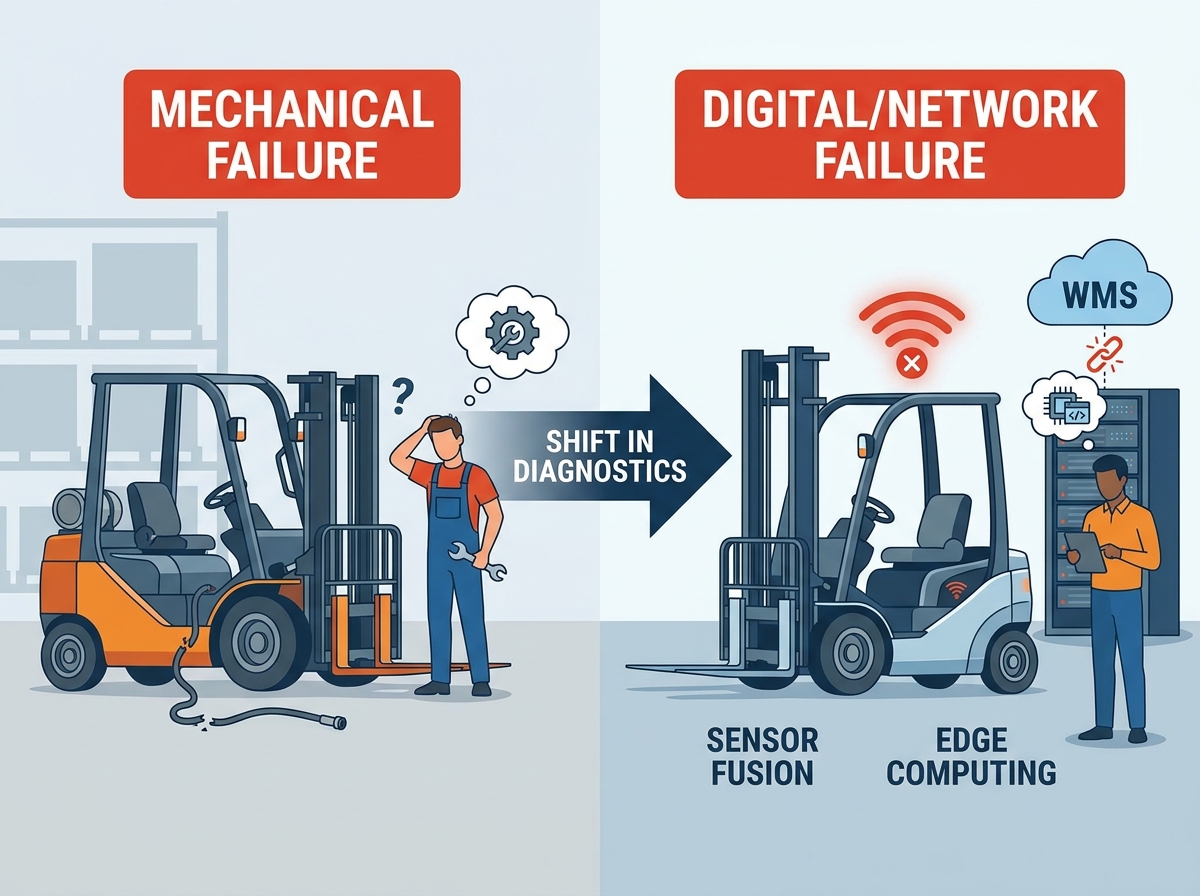
Automation is actively reshaping the modern warehousing industry. An Intelligent forklift truck promises seamless 24/7 efficiency and significantly reduced labor reliance. However, introducing autonomous robotics into a highly dynamic facility inevitably creates new, complex points of failure. Traditional material handling equipment frequently suffers from predictable mechanical breakdowns. These include leaking hydraulics or severely bent masts. Conversely, modern automated fleets face completely different operational challenges. Facility managers now grapple heavily against sensor faults, erratic network latency, and frustrating software integration roadblocks. These digital hurdles will rapidly disrupt operations if you leave them unaddressed. Transparently evaluating these harsh implementation realities remains absolutely crucial for facility leaders. Knowing the exact troubleshooting protocols effectively separates successful automation rollouts from stalled, frustrating deployments. In this comprehensive guide, we explore the top operational challenges of automated material handling. You will learn actionable solutions, practical integration best practices, and effective evaluation frameworks to ensure smooth, uninterrupted workflows.
Intelligent units rely entirely on continuous data streams. They need this constant data flow to navigate properly and receive active task orders. Wi-Fi dead zones or high network latency will cause units to abruptly stop. This creates immediate, severe workflow bottlenecks across the facility floor.
Warehouses naturally act as high-interference environments. Massive metal racking structures and constantly moving inventory disrupt wireless signals consistently. Facilities often assume standard corporate Wi-Fi can support automated fleets seamlessly. This assumption is universally flawed. Standard routers drop packets frequently during high-traffic shifts. When a forklift loses its connection to the Warehouse Management System (WMS), it halts to prevent safety incidents.
You must implement private 5G networks or industrial-grade mesh Wi-Fi. Do this long before deploying an Intelligent forklift truck fleet. Utilize units featuring robust Edge Computing capabilities. These advanced processors handle localized navigation natively. They make basic safety decisions independently. This localized processing keeps the unit safe even when temporarily disconnected from the WMS.
Upgrading digital infrastructure requires thorough operational planning. Focus your evaluation strictly on continuous operational uptime. Evaluate the tangible benefits of prevented downtime. Do not solely focus on the initial hardware specifications. Below are best practices to prevent network drops:
An autonomous vehicle triggers emergency stops immediately if its vision becomes compromised. Dust accumulation, shrink-wrap reflections, or sudden layout changes easily blind the sensors. This halts automated operations instantly and requires manual human intervention.
LiDAR and optical cameras remain highly sensitive instruments. A perfectly clean test environment during early pilot phases rarely matches reality. Busy Monday shifts bring unpredictable obstacles. Dropped pallets, stray stretch wrap, and spillages confuse single-sensor systems easily. Single-lidar setups often misinterpret a hanging piece of clear plastic as a solid concrete wall.
You must specify units featuring multi-sensor fusion technology. Combine 2D/3D LiDAR, ultrasonic sensors, and optical cameras to cross-verify obstacles continuously. If the LiDAR reads a false positive from a reflection, the ultrasonic sensor overrides the error safely. You must also establish rigorous floor-maintenance protocols. Eliminate stray debris proactively through scheduled sweeping routines.
When shortlisting specific vendors, you must demand dirty environment stress tests. Look for intelligent software flagging partial sensor occlusion actively. It should warn you before it causes a hard stop. The table below summarizes how multi-sensor fusion solves common interference problems.
| Interference Type | Failing Sensor Type | Multi-Sensor Solution | Preventative Action |
|---|---|---|---|
| Clear Shrink Wrap | 2D LiDAR (passes through) | Optical Cameras & Ultrasonic | Enforce strict wrap-clipping rules. |
| Heavy Floor Dust | Optical Cameras (lens blurring) | 3D LiDAR & Radar | Implement automated floor scrubbers. |
| Direct Sunlight Glare | Standard Vision Cameras | LiDAR & Infrared Sensors | Install dock door shading screens. |
Manual operators simply swap out depleted batteries at dedicated stations. Conversely, an Intelligent forklift truck utilizes continuous opportunity charging. Failed docking connections or unoptimized charging queues lead directly to dead units mid-aisle.
Many facilities rely strictly on basic voltage thresholds to trigger charging sequences. They completely ignore predictive fleet utilization models. This oversight creates massive overcrowding at automated charging stations during peak operational hours. A unit might attempt to dock, miss the physical connection slightly, and sit idle while draining its remaining reserve.
Integrate intelligent fleet management software to resolve this. This centralized system staggers charging based on real-time task priority. It also monitors lithium-ion health curves continuously. Conduct preventative maintenance (PM) specifically on automated charging contact pads. Regular cleaning and physical alignment checks prevent frustrating docking failures.
Ensure the charging infrastructure footprint scales linearly. You will definitely need more charging hubs as you add more units to the fleet. Follow this numbered protocol to optimize automated charging workflows:
Manual forklift operators and automated robotics often share the exact same narrow aisles. This mixed traffic frequently results in severe efficiency drops. Human workers may unknowingly block digital pathways. This forces automated units to reroute needlessly or stop entirely until the path clears.
Companies often treat automation solely as a standalone technological upgrade. They completely miss the required operational culture shift. Manual operators might walk directly in front of a moving robot, assuming it will simply stop. While the safety sensors do stop the Intelligent forklift truck, this constant halting destroys throughput metrics.
You must designate explicit automation zones within the facility. Create standardized right-of-way rules for human-robot collaboration (HRC). Deploy comprehensive workforce training extensively. Focus this training heavily on how sensors actually interpret human movement. Workers need to understand the exact deceleration zones of the automated equipment.
Empirical data shows mixed-fleet environments operate at significantly lower efficiency. Expect up to a 30% drop compared to pure-automated zones. Strict traffic management software must actively guide both human and automated units to prevent this drop. You should mandate high-visibility vests for all personnel. Some advanced LiDAR systems detect specific reflective patterns to distinguish humans from static objects faster.
Traditional mechanical teams cannot diagnose complex software bugs. Conversely, IT teams cannot fix broken drive motors or leaking hydraulics. This operational disconnect directly inflates Mean Time to Repair (MTTR). Machines sit idle while departments argue over who should fix them.
Managers often assume existing teams will seamlessly transition into the automation era. They expect standard maintenance staff to maintain electromechanical robotics easily. This assumption always fails without specialized, targeted upskilling. A technician used to replacing belts will struggle to recalibrate a malfunctioning optical sensor array.
Integrate fleet diagnostic APIs directly into your facility’s CMMS (Computerized Maintenance Management System). This critical integration automates error-code logging instantly. Establish a very clear "Quick Fix vs. Call a Pro" tier system. On-site staff handle physical PMs like greasing wheels, checking forks, and cleaning sensor lenses. Vendor SLAs strictly cover software patches and complex navigation recalibration.
Audit your vendor's remote-diagnostic capabilities carefully before signing any agreement. The ability to push over-the-air (OTA) updates remains absolutely mandatory. Remotely clearing soft errors stands as a critical evaluation criterion. A technician at the vendor's headquarters should be able to log in, clear a false error, and restart the truck within minutes.
Look far beyond the basic hardware spec sheet when choosing a provider. You must assess the maturity of the vendor's software ecosystem thoroughly. Evaluate their deployment methodology closely to ensure they understand your specific operational bottlenecks.
When selecting a provider for an Intelligent forklift truck, focus on interoperability first. Does their routing software adhere to standard industry protocols like VDA 5050? Or does it maliciously lock you into a proprietary ecosystem? Proprietary locks prevent you from mixing different robotic brands in the future. Also, investigate the Support SLAs deeply. What is the guaranteed response time? Focus specifically on remote software troubleshooting guarantees.
Ensure the units meet ANSI/ITSDF B56.5 strictly. They must meet equivalent regional safety standards for autonomous industrial vehicles. Prioritize vendors offering highly realistic pilot programs. Request a strict Proof of Concept inside a live, un-staged aisle. Demand transparent failure-rate data from similar deployments. Review the vendor evaluation chart below to structure your RFP process.
| Evaluation Dimension | Poor Vendor Indicator | Excellent Vendor Indicator |
|---|---|---|
| Software Ecosystem | Closed proprietary system only. | VDA 5050 compliant and open API architecture. |
| Deployment Testing | Requires empty facility for testing. | Demonstrates live-traffic obstacle avoidance safely. |
| Support SLA | "Best effort" response times. | Guaranteed 15-minute remote diagnostic response. |
| Safety Compliance | Self-certified safety claims. | Third-party ANSI/ITSDF B56.5 certification documented. |
Deploying an intelligent fleet fundamentally shifts your core warehouse challenges. You move away from physical labor limits and pivot toward digital and environmental management. Maintaining robust Wi-Fi, clean floors, and optimized charging schedules becomes your new daily priority.
Success does not mean the complete absence of problems. Instead, it relies heavily on your infrastructure maturity. Your network, your CMMS, and your strict floor protocols must preempt and resolve these issues swiftly. Treat automation as an ongoing operational discipline, not a one-time plug-and-play installation.
Take proactive steps immediately to ensure your facility is ready. We highly recommend booking a technical site audit soon. Download a comprehensive vendor SLA checklist to evaluate operational readiness thoroughly. Complete these critical steps before committing to a final deployment rollout.
A: Focus closely on the expected integration period, which typically spans 4 to 8 weeks. Initial facility efficiency will temporarily dip. The system needs adequate time to map the environment accurately. Routine software tweaks will resolve early edge cases and optimize routing during this critical phase.
A: Repairs now require a distinct hybrid approach. Traditional mechanics can handle physical components like tires, forks, and leaking hydraulics easily. However, you will absolutely need vendor IT support or specialized mechatronics training for advanced issues. Managing intricate sensor arrays and logic controllers requires dedicated software expertise.
A: The outcome depends entirely on the truck's processing capabilities. Units with localized edge navigation will safely stop or complete their immediate onboard task without hitting obstacles. However, regarding task allocation, the truck cannot receive new operational orders until the WMS connection is fully restored.


