
Views: 0 Author: Site Editor Publish Time: 2026-08-08 Origin: Site


Transitioning from manual to automated material handling brings new operational realities. It requires moving past high-level benefits to rigorously evaluate technical capabilities. You must weigh these capabilities against your facility’s unique physical constraints. Decision-makers often struggle to bridge traditional metrics like load capacity with advanced robotic specifications. Understanding sensor fidelity, network protocols, and autonomous navigation remains essential for success. Hardware metrics alone cannot dictate your procurement strategy.
Our goal is to provide an evidence-based framework. You will use this framework to cross-reference manufacturer specifications against your operational baseline. This approach ensures long-term safety and seamless deployment. You must evaluate an Intelligent forklift truck by merging physical footprint metrics with advanced digital capabilities. We will explore how to align hardware strictly with facility infrastructure. You will also learn how to structure a bulletproof vendor shortlist based on software readiness and integration standards.
Evaluating an automated vehicle demands strict attention to physical boundaries. Manual operators can adjust to tight corners instinctively. Autonomous systems rely entirely on programmed kinematic envelopes. You must define precise operational zones to prevent hardware collisions.
You must define exact Minimum Intersecting Aisle (MIA) requirements. MIA dictates how much space a vehicle needs for autonomous turning. Automated vehicles require larger safety buffers than human-driven counterparts. They cannot safely "cut corners" during tight maneuvers. Cross-reference standard footprint dimensions closely. Compare these dimensions directly against your facility's tightest operational zones. Measure rack-to-rack distances accurately. Account for pallet overhangs protruding into the aisle space. Narrow-aisle configurations often rule out larger counterbalanced autonomous units entirely.
Floor flatness dictates high-reach autonomous success. You must establish strict thresholds for floor flatness. Engineers measure this using F-number systems. High-reach autonomous lifts typically require strict Fmin standards. Uneven floors cause severe mast sway at maximum heights. This sway triggers false obstacle detection. It can also cause load instability.
Identify manufacturer limits on ramp gradients immediately. Note the maximum allowable threshold transitions. Sudden bumps cause sensor misalignment. They also induce traction loss during transport. Determine if your facility ramps exceed the standard five-percent gradient limit.
Autonomous systems rely heavily on stable environmental conditions. You must map specific operating ranges before deployment. Consider these critical environmental factors:
Navigation frameworks separate basic automated guided vehicles from truly advanced robotics. The perception system serves as the vehicle's brain. You must match sensor capabilities to your traffic density.
Compare primary navigation sensors rigorously. 2D LiDAR handles basic planar mapping effectively. 3D LiDAR provides volumetric perception for complex environments. Vision-based camera systems recognize specific shapes and textures. Hybrid systems combine lasers and cameras for maximum reliability.
Evaluate the necessity of scanning redundancy carefully. Secondary obstacle detection prevents low-profile collisions. Drop-off sensors detect loading dock edges. High pedestrian traffic demands maximum sensor redundancy. You cannot compromise on safety in mixed-traffic zones.
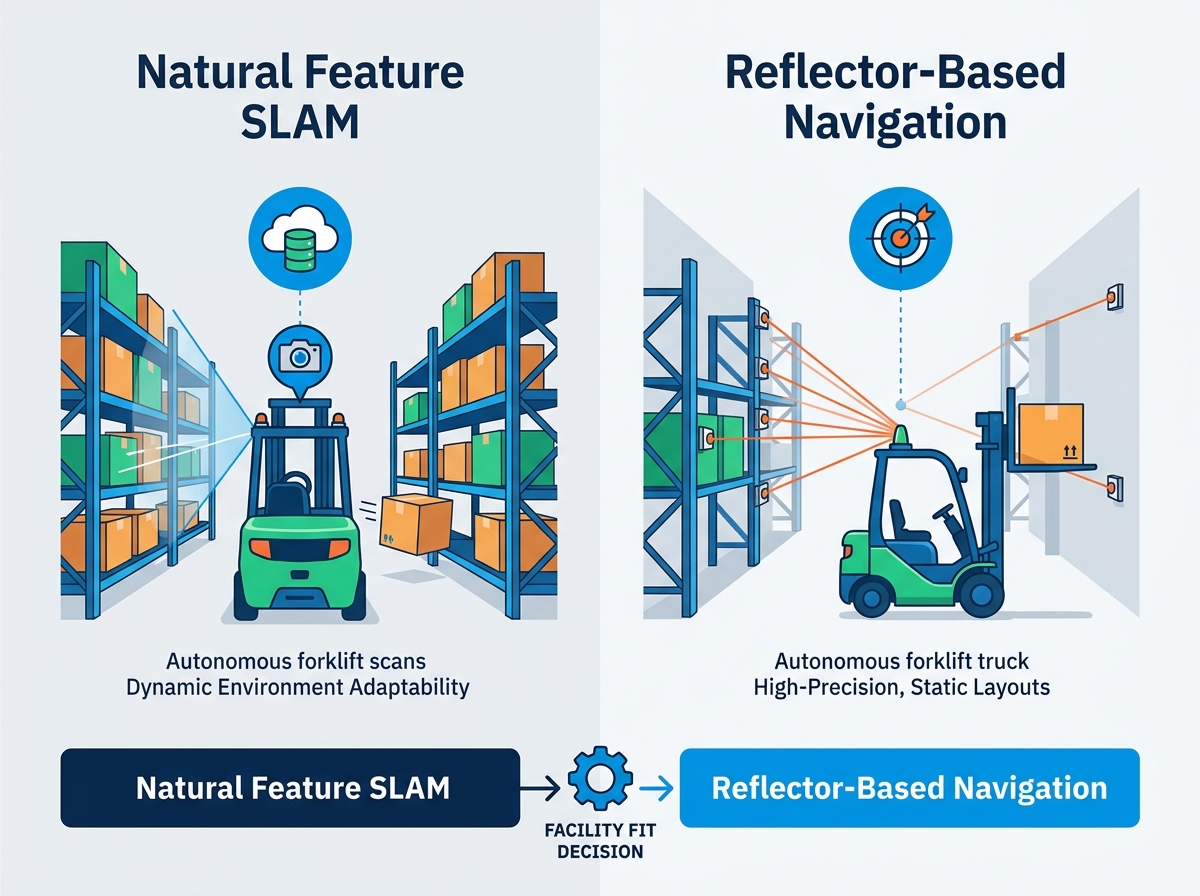
Your layout fluidity dictates the navigation framework. Choose the system matching your operational cadence.
Simultaneous Localization and Mapping (SLAM) requires no physical reflectors. Assess this framework for highly dynamic environments. It adapts well to changing layouts. Note the requirement for high onboard computing power. SLAM struggles in environments lacking distinct structural features.
Evaluate reflector-based systems for high-density environments. Static racking environments benefit greatly from this technology. Millimeter-level precision is non-negotiable for very narrow aisles. It provides absolute positioning reliability. However, it requires physical installation of wall and rack reflectors.
Obstacle avoidance dictates vehicle speeds and safety protocols. Define the exact braking distance specifications. Evaluate response times at maximum rated speeds. Test these tolerances using full payload capacities. Fully loaded vehicles possess massive kinetic energy. Braking physics limit how fast an Intelligent forklift truck can safely travel in pedestrian zones. Demand detailed kinematic data from manufacturers.
Autonomous vehicles handle loads differently than traditional manual trucks. You must analyze strict derating curves. Power management also requires an automated, systematic approach.
Analyze how automated trucks handle load derating. Capacity decreases significantly at maximum lift heights. Human operators can feel instability. Autonomous systems rely entirely on rigid mathematical models. Center of gravity calculations must be precise.
Review specifications for specialized fork types. Side-shift capabilities help correct minor pallet misalignments automatically. Payload recognition sensors remain crucial. These sensors verify pallet integrity before lifting. They prevent the vehicle from lifting damaged or severely unbalanced loads.
Assess collapsed mast height carefully. Doorways, tunnels, and mezzanines present strict vertical limits. Compare these restrictions against maximum fork height requirements. A multi-stage mast provides high reach but increases the collapsed profile. Ensure the mast design avoids blocking primary LiDAR fields of view.
Power configurations determine operational uptime. Compare battery chemistries specifically for autonomous operations.
| Configuration Type | Charge Speed | Auto-Charging Ready | Maintenance Needs | Weight Distribution |
|---|---|---|---|---|
| Lithium-ion | Fast (1-2 hours) | Highly Compatible | Zero Maintenance | Lighter (May need counterweights) |
| Lead-acid | Slow (8+ hours) | Poorly Compatible | High (Watering required) | Heavy (Acts as natural counterweight) |
| TPPL (Thin Plate) | Moderate | Moderately Compatible | Low Maintenance | Heavy |
Evaluate charging specifications thoroughly. Auto-charging station compatibility enables true 24/7 autonomy. Opportunity charging thresholds dictate when the vehicle seeks power. Calculate the total uptime-to-charge ratios to determine fleet size requirements.
Hardware represents only half of the deployment challenge. Software integration dictates daily operational success. You must ensure seamless communication between vehicles and enterprise systems.
Verify baseline API availability immediately. Standard protocol support prevents vendor lock-in. VDA 5050 compliance allows mixed-fleet management. It lets you run multiple brands under one master controller. Identify limitations in task assignment logic early. Understand how the system handles real-time inventory updating. Poor ERP integration causes severe material flow bottlenecks.
Document exact Wi-Fi or 5G coverage requirements. Seamless teleoperation requires robust networks. Look for 802.11ac or 802.11ax standards. Document latency maximums for fleet dispatch communication. Vehicles halt immediately if network connection drops. Handover times between wireless access points must be near-instantaneous.
Ensure the system architecture meets corporate IT policies. Data encryption standards must protect inventory routing data. Decide between local and cloud server dependencies carefully. Local servers offer lower latency and better security. Cloud servers offer easier remote diagnostics.
Check for strict adherence to regional safety standards. North American deployments require ANSI/ITSDF B56.5 compliance. Global or European deployments demand ISO 3691-4 certification. These standards govern emergency stops and personnel detection fields.
Procuring automated systems requires rigorous vendor evaluation. You must assess implementation capabilities alongside technical specifications. Structuring a logical shortlist prevents costly project delays.
Account for required facility modifications early. You may need extensive mirror installations for blind corners. Wi-Fi upgrades often require new access points in racking aisles. Floor grinding might be necessary to meet Fmin specifications.
Map the scope of internal staff training. Your team needs comprehensive instruction for exception handling. Routine maintenance requires updated skill sets. Operators must learn how to clear software faults safely. They must also learn how to manually override vehicles during emergencies.
Assess guaranteed response times meticulously. Hardware breakdowns require rapid on-site technician deployment. Software debugging often allows for remote resolution. Require transparent MTBF (Mean Time Between Failures) data. Request accurate MTTR (Mean Time to Repair) historical metrics. Vendors must guarantee part availability within your region.
Follow a structured methodology to narrow your options. Avoid making decisions based solely on marketing materials.
Purchasing automated material handling equipment remains a complex system integration project. It is never just a simple equipment replacement. You must align physical kinematic constraints with advanced digital capabilities. We advise decision-makers to compile a strict functional requirement document (FRD). Build this document based on the core specifications discussed here. Finalize this FRD before ever engaging vendors. As your immediate next step, recommend initiating a comprehensive site audit. Map your floors, measure your aisles, and test your network latency today.
A: Automated models require stricter safety margins. They use automated derating calculations based on sensor limitations and center of gravity models. Unlike humans, software cannot intuitively correct mid-lift instability. Therefore, automated systems artificially cap their maximum capacity at lower thresholds to guarantee absolute physical stability during autonomous high-reach maneuvers.
A: VDA 5050 is a standardized communication interface. It ensures interoperability between different brands of automated guided vehicles and central fleet management software. Mandating this standard prevents vendor lock-in. It allows you to operate mixed fleets, routing vehicles from various manufacturers through one unified control system without API conflicts.
A: Yes. They require highly reliable, low-latency network infrastructure. Standard office Wi-Fi is insufficient. Vehicles need continuous communication for dispatching and traffic control. High-latency networks or dead zones cause localized drop-offs. When connection drops, safety protocols force the vehicles to halt operationally, creating severe warehouse traffic jams.
A: Deployment typically takes three to nine months. The timeframe spans from initial site mapping and CAD layout to software API integration, testing, and full commissioning. Complexity directly drives the timeline. Facilities requiring extensive network upgrades, floor grinding, or complex ERP integrations will experience longer deployment phases than simple, isolated operations.


